

by Daniyal Hassan, Last updated: June 2, 2025
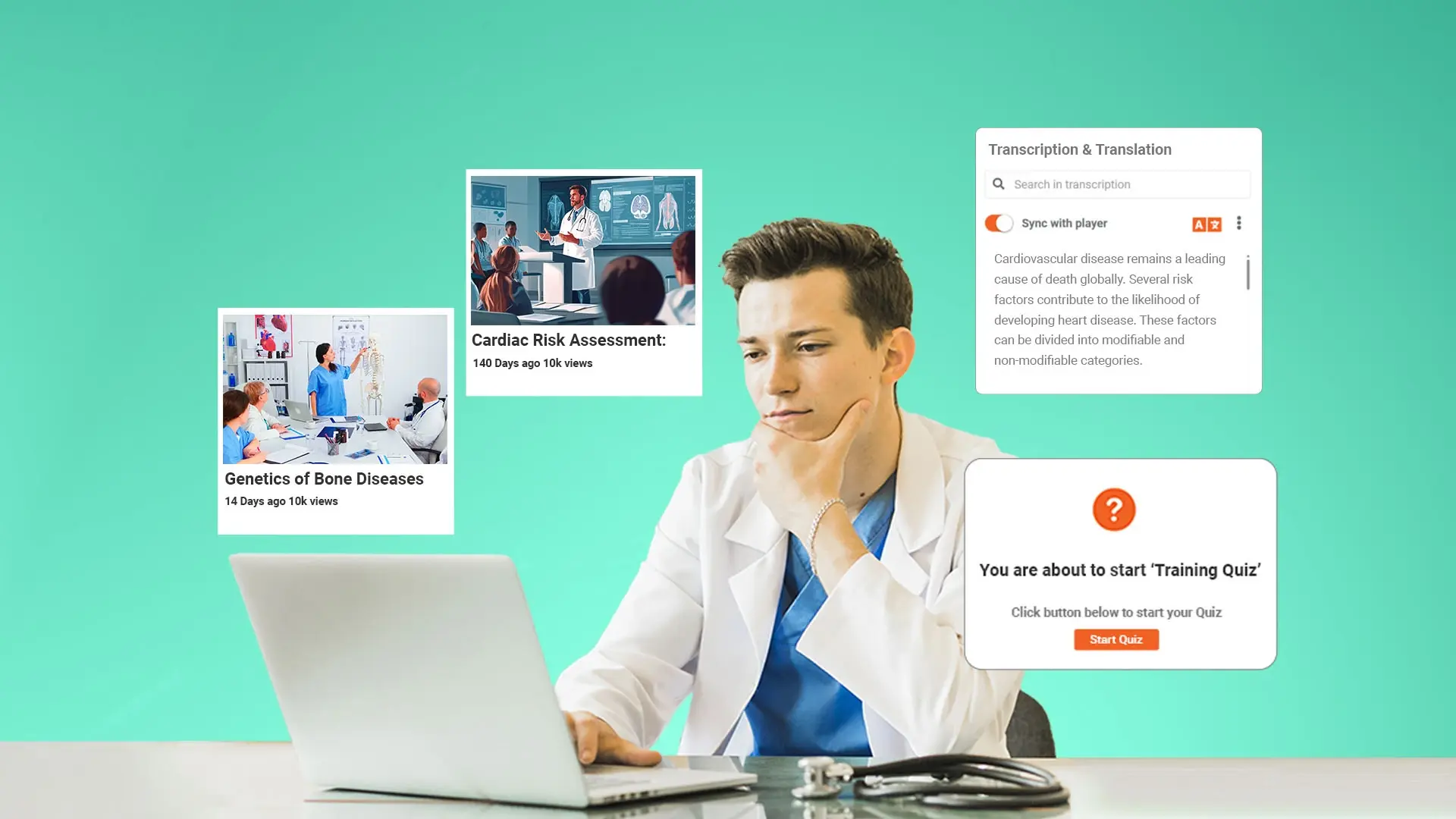
Continuing Medical Education (CME) is vital for improving patient care and reducing medical errors, yet traditional methods face challenges like high costs, low engagement, and accessibility gaps. This blog explores how a healthcare video platform simplifies CME delivery, ensuring flexible, personalized, and HIPAA-compliant staff training.
Heart-related diseases and cancer are two of the leading causes of patient death. But do you know what comes next? It's medical negligence, and the reason it ranks third is that it happens so frequently, almost daily, at healthcare facilities. And they don't go unnoticed.
According to a Forbes publication, 33% of healthcare professionals (HCPs) in the US are sued for their alleged negligence toward patients.
This is why continuing medical education (CME) is essential for training the medical and paramedical staff, including doctors, nurses, and clerical staff. Poor healthcare staff training leads to mishaps, resulting in ugly lawsuits, stained reputations, and a loss of patients' trust. You see, the consequences of not having an effective CME program can be highly damaging.
CME plays a vital role in keeping healthcare professionals at the top of their game of saving people's lives. However, despite the many benefits of CME, traditional CME methods often come with their own set of challenges—high costs, inconsistent training quality, and accessibility issues, to name a few.
The good news is that an effective solution exists in the form of a healthcare video platform. A video platform simplifies healthcare staff training and ensures that professionals receive the education they need efficiently and effectively.
In this blog, we'll explore why CME is so important, the challenges associated with traditional training methods, and how a Healthcare Video Platform can revolutionize CME delivery while keeping everything HIPAA-compliant.
The Growing Importance of Continuing Medical Education (CME)
Continuing Medical Education (CME) is like a toolkit for healthcare professionals, keeping their skills sharp and knowledge fresh.
Think of it as a collection of activities, including workshops, seminars, courses, and conferences, that help doctors, nurses, and other healthcare workers stay current on the latest in medical science and best practices.
However, CME isn't just about ticking off a box to meet regulatory requirements. It's much more than that. It's about ensuring that every time a healthcare professional steps into a patient's room, they're equipped with the most up-to-date knowledge to provide the best care possible.
In today's fast-paced medical world, CME is becoming increasingly important because it's the key to continuous learning and ongoing improvement in patient care.
Regulatory Requirements for Healthcare Professionals
Various medical boards and accrediting organizations mandate CME to ensure that healthcare professionals remain competent and compliant with current standards.
For instance, in the United States, state medical boards mandate that physicians complete a specific number of CME hours to maintain their licenses.
This requirement varies by state; for example, physicians in Georgia must earn 40 CME credits every two years, while those in Illinois must complete 150 CME credits every three years.
Similarly, nurses and other healthcare professionals have their own CME requirements, which vary by state and profession. These regulations ensure that healthcare practitioners continually update their knowledge and skills in line with evolving medical standards. A healthcare video platform can streamline this process, offering tailored content that meets these diverse regulatory requirements.
Benefits of CME for Patient Care and Professional Development
CME has several benefits, both for patient care and healthcare practitioners' professional growth. CME ensures that their healthcare providers know about the latest treatments, technologies, and clinical guidelines for patients.
This leads to improved patient outcomes and safer, more effective care. For healthcare professionals, CME provides opportunities for career advancement, skill enhancement, and specialization in areas of interest. It fosters a culture of lifelong learning and helps practitioners stay competitive in their field.
Challenges in Traditional Healthcare Staff Training
As mentioned earlier, despite the critical importance of CME, traditional training methods present several challenges that can hinder their effectiveness. These challenges include logistical difficulties, financial constraints, and limitations in the quality and relevance of the training provided.
As the healthcare industry evolves and the demands on professionals increase, it becomes increasingly clear that traditional training methods may not be sufficient to meet healthcare staff's diverse and growing needs.
The following are some of the pressing challenges in traditional healthcare staff training:
Scheduling Conflicts and High Costs
Consider how challenging it is to get everyone in the same room simultaneously. Healthcare professionals, whether doctors, nurses, or other staff, have incredibly demanding schedules. They work around the clock, and their availability can be unpredictable.
This makes it challenging to find a time that works for everyone when planning in-person training sessions. Imagine organizing a meeting where every participant has different shifts, on-call duties, or emergencies that might arise unexpectedly. It's like trying to solve a puzzle with constantly moving pieces.
Now, add the costs into the mix. In-person training isn't just about booking a room. It often involves renting a venue, arranging travel, and providing accommodation if participants come from different locations.
These expenses can add up quickly and become a significant barrier for smaller healthcare facilities or institutions with limited budgets, leading to fewer training opportunities. Even for larger institutions, the financial strain can limit how frequently they can offer such training, making it less accessible to those who need it most. This is especially true because of the Federal Sunshine Act, which mandates the financial reporting of certain payments regarding CME spending.
Inconsistent Quality of Training
The quality of in-person training can be mixed. It largely depends on who leads the session. For instance, a highly experienced and expert instructor will likely provide valuable insights and a rich learning experience. On the other hand, the training may not be substantial if the instructor lacks expertise or fails to connect with the audience.
This inconsistency is a significant issue since not all healthcare professionals receive the same quality of education. Moreover, the materials used in these sessions can vary widely. Well-prepared, engaging resources might support some sessions, while others might rely on outdated or less relevant materials that can prove counterproductive to healthcare professionals' skills development.
This disparity can lead to uneven learning experiences. Some participants may walk away feeling well-informed, while others may feel that the training didn't meet their needs. This inconsistency can have real consequences in a field as critical as healthcare, where continuous learning is essential for providing the best patient care. After all, it's a matter of someone's life and death.
Although somewhat better than in-person training, traditional online training for healthcare staff comes with its own challenges. These challenges are discussed as follows:
Lack of Engagement and Interaction
Online training can sometimes feel like watching a lecture through a one-way mirror—you see everything happening, but there's no way to interact or participate. You can say that the display screen acts as a significant barrier between you and the training instructor.
Traditional online courses often rely on static content like slideshows or pre-recorded videos, which, while informative, can be dry and not engaging enough to grab your attention. When you're just passively watching or reading without any chance to ask questions, discuss ideas, or get immediate feedback, your mind can easily wander.
This lack of engagement is a significant issue because it directly impacts how much you learn and retain. Wouldn't it be difficult to learn a complex medical procedure by just watching a video without the ability to ask follow-up questions or practice in real-time? It would, right?
Because it's not the same as being in a live setting where you can interact with the instructor and peers, this disconnect often leads to decreased motivation and lower completion rates, making the training less effective overall.
Traditional online training cannot also provide a personalized learning experience. Without interactive videos, quizzes, and assessments tailored to individual needs, learners miss the opportunity to focus on areas where they need the most improvement.
Moreover, you can't track learners' engagement or measure completion rates for individual content, making it difficult to gauge the training's impact. You cannot identify top-performing content or users, nor can you monitor technical issues like device usage, buffering, or video load times. Frustrating, right? Isn't it?
To cut it short, without the ability to export detailed analytics, organizations are left in the dark about the actual effectiveness of their training programs.
One-Size-Fits-All Approach
Another major issue with traditional online training is its one-size-fits-all approach. Healthcare encompasses a wide range of specialties, each with its own specific challenges and requirements. However, many online courses target a broad audience with generic content, overlooking the unique needs of different roles.
For example, a course designed for all healthcare professionals might cover general topics, but it likely won't address the specific details needed by a surgeon or specialist.
For instance, a primary care physician and a radiologist deal with very different aspects of patient care, and their training needs reflect that. When a course doesn't cater to these specific needs, it can feel irrelevant or superficial to the learner, which reduces its impact and effectiveness.
While online training has the potential to reach a broad audience, it often fails to deliver content that truly resonates with each learner. Customization is critical in healthcare education, and the absence or lack of it can make the training less meaningful and less effective for those who need it most.
Geographical Barriers and Time Constraints
If you are a healthcare professional in a remote or underserved area where geographical barriers limit access to quality CME, this will resonate with you. Traveling to in-person training events might not just be challenging for you—it could be nearly impossible. Right?
For someone working in an isolated location, the nearest training center could be hundreds of miles away. Taking time off, traveling, and possibly staying overnight just to attend a session becomes a huge hurdle. Worse, if the training session turns out to be a waste of time.
In addition, healthcare professionals often have to manage busy and unpredictable schedules. When you're trusted with saving people's lives, it's hard enough to find time during the day to grab lunch, let alone attend a scheduled training session that might not align with your working hours.
Even if you're not in a remote area, time constraints can make it challenging to participate in traditional training sessions. These barriers can lead to missed learning and professional development opportunities, which are crucial in a constantly evolving field.
Diverse Training Needs for Different Healthcare Roles
The healthcare field is incredibly diverse, with professionals working in a wide range of roles, each requiring specific types of training. A nurse, for example, might need hands-on training in patient care techniques, while a radiologist needs the latest updates on imaging technology. Two completely different things.
Traditional training methods often don't account for this diversity. They tend to offer a more generalized approach, which might work well for some but leaves others with significant gaps in knowledge and skills.
Let's say a training program is designed for a broad audience—it might cover basic topics that are useful to everyone, but won't delve deeply into the specialized areas that different professionals need.
This can be particularly frustrating for those looking for targeted learning to improve their practice. The result? Radiologists might not get the detailed updates they need on new imaging techniques, or nurses might miss out on critical training in patient care advancements.
You can say that one-size-fits-all training isn't a good option in a complex and varied healthcare field. The unique needs of each role demand a more tailored approach to ensure that every professional has the knowledge and skills required to excel in their specific area.
The Role of Healthcare Video Platform in Transforming CME
Healthcare video platforms have revolutionized how CME is delivered, addressing many of the challenges associated with traditional methods and greatly enhancing the overall training experience.
Centralized Content Management
One of the most valuable aspects of a healthcare video platform is its ability to centralize all training materials into a single, easily accessible repository. This centralized video library ensures that healthcare professionals can access all the educational resources they need, whenever needed, from any location.
The ability to organize content using folders, tags, and filters makes navigating this library straightforward, allowing users to quickly find specific videos or documents without sifting through clutter.
Additionally, healthcare organizations can benefit from industry-standard security features like advanced encryption and IP/domain restrictions, which keep sensitive content safe and accessible only to authorized personnel.
Moreover, the platform supports seamless updates to training materials, ensuring all practitioners can access the most current information and guidelines. This is crucial in the healthcare industry, where staying updated with the latest medical practices can significantly impact patient care. A healthcare video platform standardizes training materials across different locations and roles, ensuring that all professionals receive a consistent, high-quality education.
Interactive and Engaging Content
Unlike traditional training methods, a healthcare video platform takes advantage of multimedia elements such as videos, animations, quizzes, and interactive simulations to create a more engaging learning experience.
These interactive features help capture and maintain learners' attention, making the training process more dynamic and enjoyable. For example, interactive simulations allow professionals to practice skills in a virtual environment, reinforcing learning and enhancing skill development.
This hands-on approach not only improves retention but also ensures that professionals are better prepared to apply their knowledge in real-world scenarios.
On-demand Access
One of the most significant benefits of a healthcare video platform is the ability to offer on-demand access to training content. This flexibility allows healthcare professionals to engage in CME at their own pace and on their own schedule, which is crucial due to the demanding and often unpredictable nature of their work.
Whether they have a few minutes during a break or a longer period in the evening, healthcare professionals can access the training they need without facing constraints from fixed schedules.
Enhanced Search and Discovery:
Finding the right content quickly is crucial, especially in a busy healthcare environment. Healthcare video platforms come equipped with AI-powered search capabilities that allow users to search for spoken content, tags, speakers, objects, and more within videos.
Features like automatic speech recognition enable professionals to jump to precise moments in a video, making the search process highly efficient. This advanced search functionality saves time and enhances productivity, ensuring that healthcare professionals can focus on what truly matters—learning and applying new skills.
Personalized Learning Paths
Healthcare video platforms offer the flexibility to create personalized learning paths tailored to individual healthcare professionals' specific needs and interests.
This customization is a game-changer, allowing professionals to focus on areas most relevant to their practice. For instance, a nurse might prioritize patient care techniques, while a radiologist might need the latest updates on imaging technology.
By providing content that is directly aligned with their roles, these platforms make CME more effective and relevant, ultimately enhancing the professional growth of each learner.
Key Features of an Effective Healthcare Video Platform
When selecting a healthcare video platform, several key features should be considered to ensure that it meets the institution's and its staff's needs.
Analytics and Reporting:
Monitoring and analyzing learner engagement and performance is crucial for evaluating the effectiveness of CME programs. A robust healthcare video platform should offer comprehensive analytics and reporting tools that provide detailed insights into learner progress, engagement trends, completion rates, and assessment outcomes.
These analytics are not just about numbers—they help institutions identify which content resonates with learners and which areas might need improvement. For instance, the platform should track key metrics such as total impressions (how many users landed on the playback page), total views, completions, and the overall time spent on videos.
This data is often presented in visual formats, such as time-series charts, which make it easier for administrators to spot trends and make data-driven decisions. Additionally, the ability to view user-level analytics allows institutions to assess the engagement of individual users, seeing who is most or least engaged with the content.
The platform should also support exporting these reports in formats like CSV, allowing for further analysis or integration with other systems. This feature is especially important for ensuring compliance with CME requirements, as it enables institutions to maintain detailed records of learner progress and report these to accrediting bodies if necessary.
By leveraging these analytics, healthcare organizations can continuously refine their CME programs to ensure they are meeting the educational needs of their staff.
Integration Capabilities
To maximize the utility of a healthcare video platform, the platform should support seamless integrations with a range of third-party applications and services. This ensures that the platform fits seamlessly into an institution's existing IT infrastructure and enhances its overall functionality.
The platform should integrate with popular video conferencing tools like Zoom, Microsoft Teams, and Cisco Webex, allowing the automatic ingestion and storage of recorded meetings within the platform's secure video library. This feature ensures that valuable training sessions are preserved and available for on-demand viewing, extending their reach and impact.
Integration with content management systems such as SharePoint streamlines workflows by enabling the direct ingestion and storage of media assets in the video platform. This enhances content management, making media resources efficiently organized and accessible.
Incorporating analytics tools like Google Analytics provides deeper insights into audience engagement and video performance. This capability allows institutions to track and analyze how content is consumed, thereby optimizing the effectiveness of training and educational materials.
For a more tailored experience, the platform should also integrate with Electronic Health Records (EHR) systems to track Continuing Medical Education (CME) credits directly within a practitioner's profile.
This integration reduces administrative burdens by aligning CME activities with the institution's goals and workflows. Similarly, integration with Learning Management Systems (LMS) can improve the management and delivery of educational content.
Additionally, offering a flexible API for custom integrations is essential for institutions with specific needs. This flexibility allows for creating unique workflows and automation that enhance the platform's functionality and adapt it to various IT environments.
By ensuring these integration capabilities, the healthcare video platform provides a unified and efficient environment for CME delivery, content management, and performance tracking, ultimately supporting the institution's educational objectives and operational efficiency.
Scalability and Accessibility
As healthcare institutions expand, their training needs evolve, and an effective video platform must be able to scale accordingly.
Scalability is not just about handling more users or managing multiple portals and accounts under one deployment.
This feature is crucial for large healthcare organizations with different departments, regions, or business divisions, each requiring tailored training programs.
This feature is crucial for large healthcare organizations with different departments, regions, or business divisions, each requiring tailored training programs.
Accessibility is another critical factor. The platform must be user-friendly, catering to healthcare professionals with varying levels of technological proficiency.
This includes features like mobile compatibility, which ensures that training content can be accessed on any device, whether a desktop computer, tablet, or smartphone. The platform should also support a wide range of media formats over 255, as mentioned in the document, and provide smooth, bufferless playback.
This ensures that training materials are always accessible, regardless of the device or network conditions.
The platform's adaptability is further enhanced by features like adaptive bitrate streaming, which adjusts video quality based on the user's internet connection, preventing interruptions during playback. This is particularly important for healthcare professionals who may need to access training content in different environments, from hospital networks to remote locations with less reliable internet access.
Multi-stream View
The ability to view multiple video streams simultaneously serves as an invaluable tool for healthcare professionals engaged in CME. A multi-stream view feature lets users watch up to four videos at once, offering a comprehensive perspective crucial for medical education.
This feature is particularly useful during multi-camera event analyses, such as surgical procedures or complex case studies, where different angles and perspectives can be examined side by side.
The platform should support synchronized playback of these streams, ensuring that all angles are perfectly aligned for a seamless analysis experience.
The multi-stream view should also offer customizable layouts, allowing users to drag media from the library, snap players into place, resize them, and create a cohesive video mosaic that enhances learning and understanding.
This capability eliminates the need for switching between tabs or dealing with disjointed footage, making it easier to see the bigger picture and focus on the content that matters most.
SSO Support
Managing multiple login credentials can be a significant burden, especially in large healthcare institutions. A robust healthcare video platform should offer Single Sign-on (SSO) support, simplifying the login process and reducing the risk of password fatigue.
With SSO, users access the platform using a single set of credentials synchronized across multiple systems within the organization. This not only enhances security but also improves productivity by minimizing the time spent on login procedures.
The platform should support the System for Cross-domain Identity Management (SCIM) for automating user provisioning, ensuring it updates permissions in real-time as the user roles change.
Additionally, SSO integration should extend to third-party providers like Azure AD, Okta, and Google, providing flexibility and ensuring seamless integration into existing IT infrastructures.
This feature is particularly important for protecting video assets, as it allows administrators to manage access to multiple applications securely and efficiently.
Automatic Transcription
Automatic transcription is a crucial feature for enhancing both accessibility and searchability within a healthcare video platform. This feature allows instant generation of text transcriptions for video and audio content, making it easier to review and search through recorded CME sessions.
The platform should also support automatic translation of these transcriptions into multiple languages, enabling global access to CME content. This is particularly valuable for institutions that serve a diverse, international audience, as it ensures that content is accessible to all healthcare professionals, regardless of language barriers.
In addition to transcription and translation, the platform should offer automatic captioning, providing real-time subtitles for videos and ensuring that all spoken content is accessible.
Empower CME Success with a Healthcare Video Platform
Continuing Medical Education (CME) is critical to reducing medical errors, improving patient outcomes, and ensuring healthcare professionals remain at the top of their game. However, traditional training methods often fall short due to high costs, scheduling issues, and a lack of engagement.
A healthcare video platform solves these challenges by offering centralized content management, personalized learning paths, interactive training, and HIPAA-compliant video delivery. It not only simplifies healthcare staff training but also ensures consistent, engaging, and scalable education across departments and regions.
Ready to modernize your CME strategy? Start your free trial or contact us to explore how EnterpriseTube empowers smarter, secure, and scalable healthcare training for professionals worldwide.

People Also Ask
What is a healthcare video platform?
A healthcare video platform is a secure digital solution used to deliver, manage, and track medical education and training content. These platforms are designed to meet HIPAA compliance and support Continuing Medical Education (CME) by providing on-demand access, personalized learning paths, and real-time analytics for healthcare professionals.
How does a healthcare video platform support Continuing Medical Education (CME)?
A healthcare video platform enhances CME delivery by offering on-demand, interactive video training that fits into busy schedules. It enables centralized content management, tracks learner progress with advanced analytics, and supports integrations with EHR and LMS systems for streamlined credit tracking and compliance.
What are the benefits of using a video platform for CME training?
Benefits include flexible, 24/7 access to training, improved learner engagement through interactive content, personalized learning paths, scalable deployment across departments, and automated tracking for CME credits. These features improve both the quality and efficiency of healthcare staff training.
Why is video-based CME more effective than traditional methods?
Video-based CME overcomes key limitations of traditional training, such as scheduling conflicts, high costs, and inconsistent quality, by providing standardized, engaging, and easily accessible content. It also supports analytics and real-time feedback, which helps optimize learning outcomes.
Is a healthcare video platform HIPAA-compliant?
Yes, leading healthcare video platforms are built to be HIPAA-compliant, incorporating features like secure encryption, access control, role-based permissions, and audit logs. These protections ensure patient data confidentiality and meet legal compliance standards.
How do healthcare video platforms personalize learning for different roles?
These platforms allow administrators to create custom learning paths for specific job functions, such as nurses, physicians, and radiologists, ensuring that training is relevant and aligned with their clinical responsibilities and CME requirements.
Can CME training videos be accessed remotely?
Absolutely. Healthcare video platforms support remote access via mobile and desktop devices. This ensures that professionals in remote or underserved areas can still complete their CME requirements without geographic or time limitations.
What features should I look for in a CME video platform?
Key features to look for include:
- Secure, HIPAA-compliant infrastructure
- On-demand video access
- Interactive content support (quizzes, polls)
- Personalized learning paths
- Real-time analytics and reporting
- Integration with LMS, EHR, and SSO systems
- Scalability across departments and teams
How do healthcare organizations track CME completion using video platforms?
Video platforms provide built-in analytics dashboards that track views, engagement, quiz results, and completion rates. This data can be exported for compliance reporting and used to issue CME certificates automatically.
Why is CME training important for patient care?
CME ensures that healthcare providers stay up to date with the latest clinical practices, technologies, and safety standards. This leads to improved diagnoses, treatment outcomes, and patient satisfaction, while also minimizing medical errors and legal risks.
Jump to
Solving Machinery Training Challenges with a Video Training Platform

VIDIZMO EnterpriseTube: A Video Platform for Banks to Engage, Train, and Support

No Comments Yet
Let us know what you think